Planetary Kp index
Establishing data connection…
Cosmic Mission Control
Monitor rocket launches, orbital activity, cosmic events, and discoveries from across the universe.
Explore the 3D Solar System → · Plan a night of observing →Shared provider caches refresh on their own schedules. Manual refresh is limited to once per minute.
Establishing data connection…
A curated, source-linked calendar. Visibility depends on your location and conditions. Meteor peak nights use local observing dates.
November 16, 2026
Mars and Jupiter appear about 1.2 degrees apart on the sky. They remain far apart in space.
Where both planets are above the horizon in a dark sky; check your local sky chart.
Astronomical Society of Brunei Darussalam ↗Peak night · November 16–17, 2026
Earth encounters debris from comet Tempel–Tuttle. A meteor storm is not predicted.
Where Leo rises before dawn; weather and moonlight affect visibility.
American Meteor Society ↗Full Moon · November 24, 2026 at 14:54 UTC
A full Moon near perigee appears slightly larger than an average full Moon.
Worldwide when the Moon is above the horizon.
NASA Science ↗Peak night · December 13–14, 2026
A strong annual shower with bright meteors and favorable moonlight conditions this year.
Best in the Northern Hemisphere; also visible at lower rates farther south.
American Meteor Society ↗Full Moon · December 24, 2026 at 01:28 UTC
The final supermoon of 2026. Local calendar dates vary with time zone.
Worldwide when the Moon is above the horizon.
NASA Science ↗February 6, 2027 · local timing varies
The Moon leaves a ring of sunlight visible along the annular path. Use certified solar viewing protection.
Annular path through Chile, Argentina and the Atlantic; partial eclipse in parts of South America and Africa.
NASA Science ↗August 2, 2027 · local timing varies
The Moon’s shadow crosses a narrow path of totality. Check local circumstances and safe viewing guidance.
Southern Spain, North Africa and parts of the Middle East.
NASA Science ↗05 / Our dynamic star
Observed conditions from NOAA’s Space Weather Prediction Center. These readings are not forecasts or local aurora predictions.
Establishing data connection…
06 / Worlds of our solar system
Five worlds. Five different stories. Educational imagery, not current telescope views; planet sizes are not to scale.

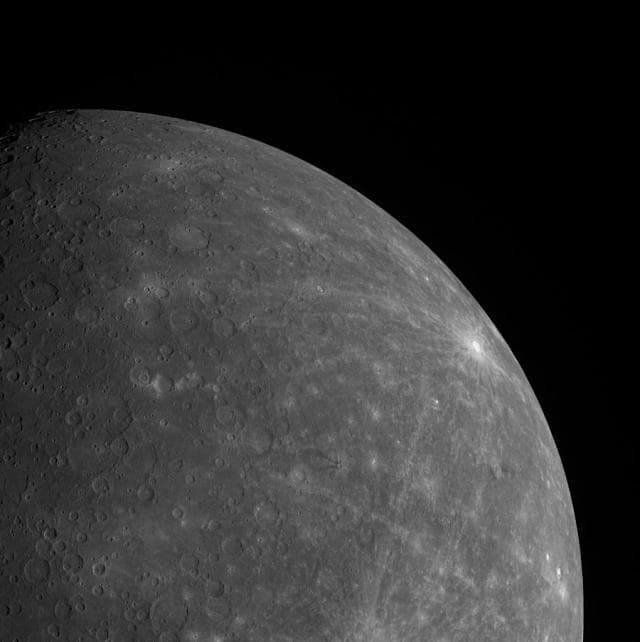
Rocky planet
A year on Mercury lasts just 88 Earth days.
Mercury is the smallest planet in our solar system. Its thin exosphere cannot redistribute heat like a thick atmosphere, so surface temperatures vary enormously between day and night.
Planet facts · NASA ↗Image: NASA / Johns Hopkins APL / Carnegie Institution of Washington. Image source

Rocky planet
Venus is the hottest planet, despite being farther from the Sun than Mercury.
Its dense carbon dioxide atmosphere traps heat through an extreme greenhouse effect. Venus rotates in the opposite direction to most planets; one rotation takes about 243 Earth days.
Planet facts · NASA ↗Image: NASA / JPL-Caltech. Image source

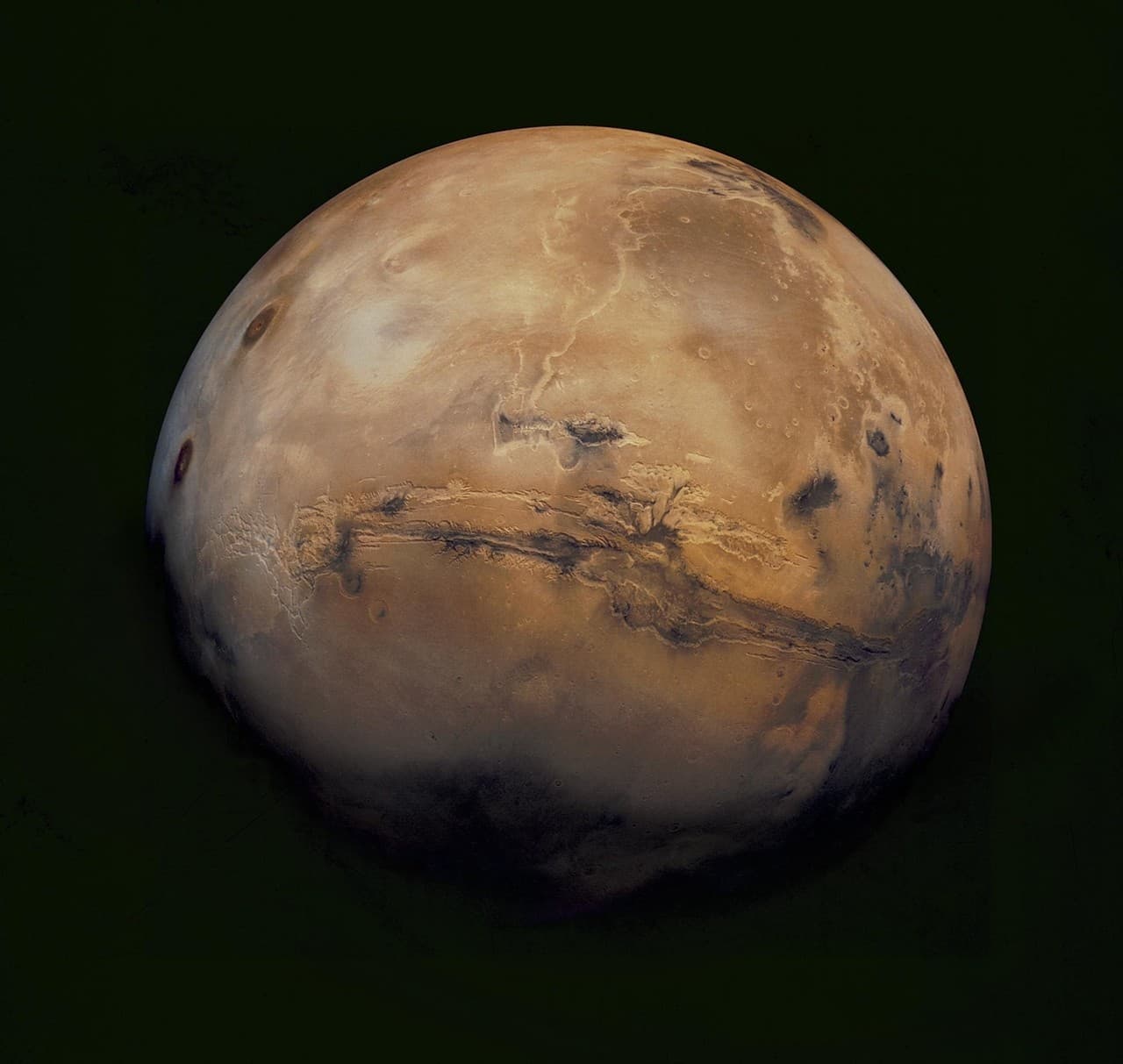
Rocky planet
A day on Mars is a little longer than a day on Earth.
A Martian solar day, called a sol, lasts about 24.6 hours. Iron minerals that oxidized in its soil give Mars its reddish appearance. Ancient landforms preserve evidence that liquid water once flowed on its surface.
Planet facts · NASA ↗Image: NASA / USGS · Viking mosaic, PIA04304. Image source

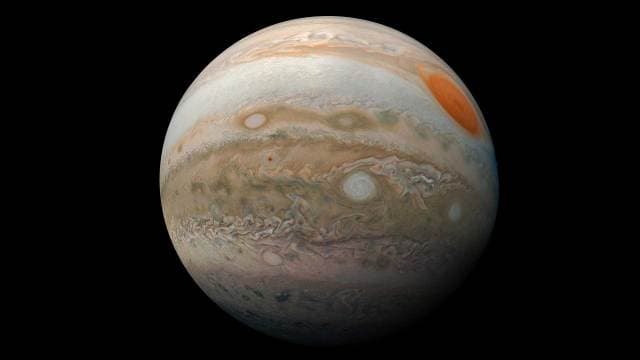
Gas giant
Jupiter is more than twice as massive as all the other planets combined.
Jupiter is composed mainly of hydrogen and helium, with no solid surface like Earth’s. Its bright zones and darker belts trace clouds moving through a rapidly rotating atmosphere.
Planet facts · NASA ↗Image: Kevin M. Gill (CC BY) / NASA / JPL-Caltech / SwRI / MSSS · enhanced color. Image source

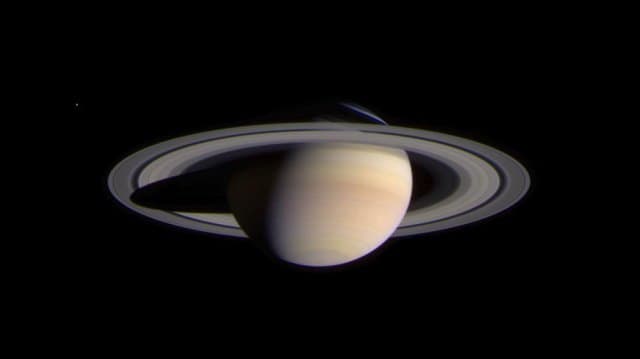
Gas giant
Saturn’s rings consist mainly of pieces of ice, with rock and dust mixed in.
The rings are countless separate particles orbiting Saturn, not a solid disk. Saturn is composed mostly of hydrogen and helium and has a lower average density than water.
Planet facts · NASA ↗Image: NASA / JPL / Space Science Institute. Image source
07 / Keep asking questions
A daily perspective
· rotates at midnight UTC
Mercury completes one trip around the Sun in about 88 Earth days.
Scientific source · NASA ↗Loading published discoveries…
Learn to read a signal
Simulation — Not a real extraterrestrial signal
A receiver measures changing electromagnetic fields. This illustration varies the wave’s amplitude; its shape carries no evidence of life or contact.
Reduced-motion preference: waveform stays still.
Radio waves · NASA ↗From our Space News desk
Latest sourced article ·
NASA’s SpaceX Crew-13 astronauts have arrived at Kennedy Space Center as preparations intensify for their upcoming mission to the International Space Station.
Source: NASA ↗Read discovery →